
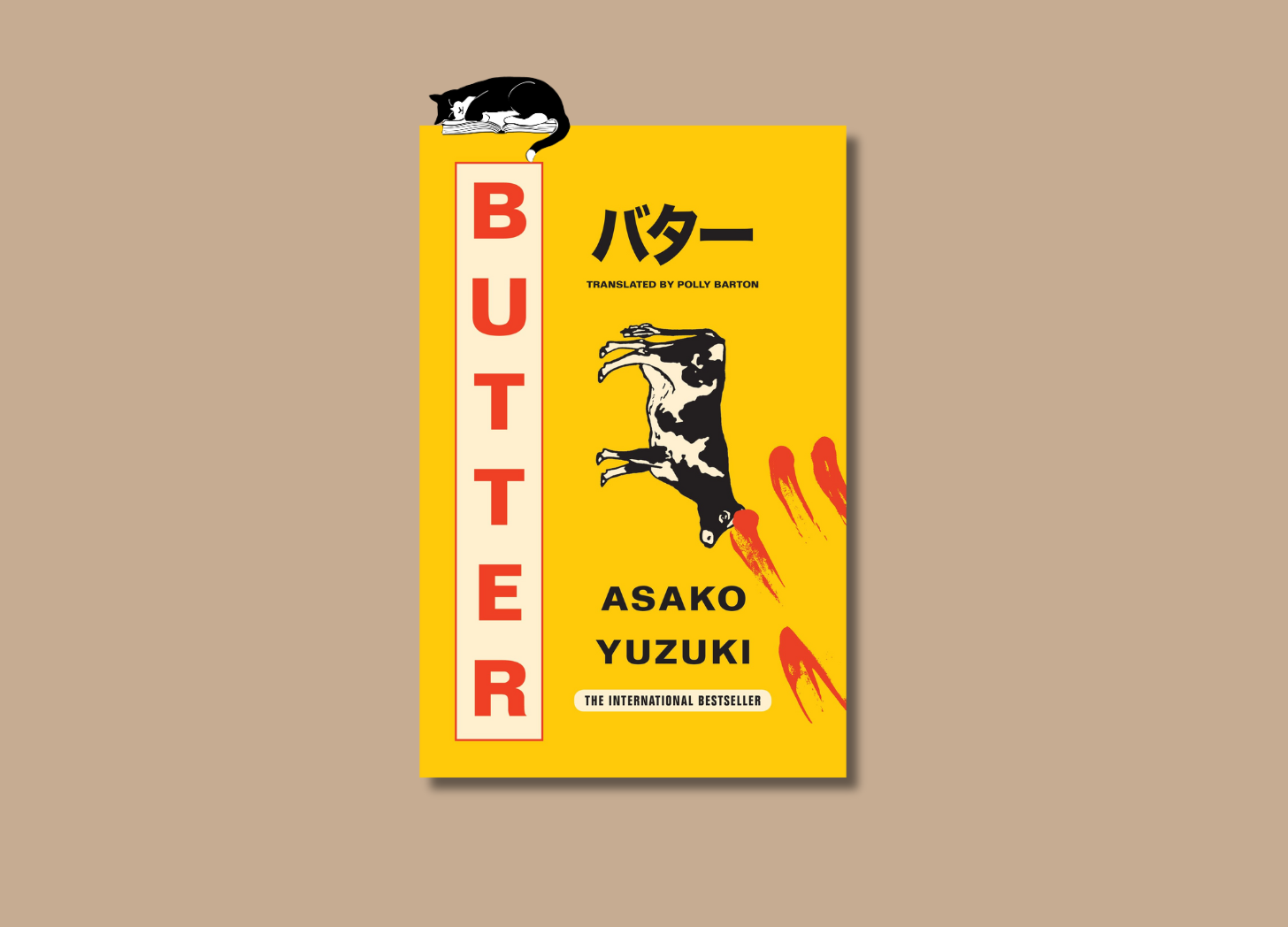
In the UK, we have an idiom where we say ‘butter wouldn’t melt in their mouth’. For example, I might say, ‘She looks innocent, but I knew deep down that butter wouldn’t melt in her mouth’. This is to say that someone who appears innocent on the surface, is in reality untrustworthy, or there is at least the assertion that they may not be what they seem.
This makes Butter perhaps the perfect title for Asako Yuzuki’s novel. Published in 2017 and translated by Polly Barton from Japanese into English, the novel was inspired by a real-life serial murder case in Japan – the Konkatsu killer, otherwise known as Kanae Kijima (木嶋 佳苗). Kijima is a Japanese fraudster and serial killer, convicted for poisoning three would-be husbands and suspected of another four more from 2007-2009. Her nickname was given to her as a result of frequenting “konkatsu” (marriage-hunting) websites.
In Butter, Kijima’s fictional replacement is Manako Kajii, a young woman who has similarly been convicted for a string of murders of men she had been dating or previously living with. The Japanese public are astounded by the case, partly because it is believed that Kajii was able to lure in many of her victims through her skilled home cooking, but also because ‘this woman, who had led several men around by the nose […] was neither young nor beautiful’. The discussion around female beauty and Japanese beauty standards is a consistent theme throughout the novel, with female characters often citing Kajii as a rebel against the Japanese standards, whilst men look on at her with scorn.
The case attracts the attention of our protagonist Rika Machida, a young reporter at a men’s weekly magazine, who is curious to know more about Kajii’s motivations and her story. After Rika’s closest friend, Reiko, suggests she writes to Kajii and asks for the recipe of her beef stew, the two begin conversing.
Rika is fascinated by Kajii the moment she meets her, and is strongly motivated to understand her perspective, despite the two holding very different value systems. Kajii is in many ways extremely conservative, and views other women with a great deal of scorn. She makes it clear to Rika very early on that she does not like feminists, and believes women have a responsibility to serve men in a domestic environment.
Despite this, Rika soon discovers that Kajii is full of dichotomies, as she also possesses an intense need for independence. At one point in the novel, after speaking to others who knew Kajii and her victims, Rika ponders that Kajii had been ‘masquerading as a woman in search of a marriage partner, but the truth was that she had no intention of belonging to anyone.’ Kajii’s declarations that women belong in the home are at odds with her desire to never marry or settle down with someone.
She believes women must serve men, yet doesn’t ever want to be tied to one indefinitely. She wants freedom, but then seeks out men who only want a housewife, someone to do their chores and fulfill their needs, but never to have a personality or hobbies of their own.
The more time Rika spends researching Kajii and visiting her at the Detention House, she notices changes within herself. For a start, Rika gradually puts on weight as a result of trying recipes Kajii has instructed her to try, and eating out more at fancy restaurants. This change in appearance garners a lot of attention from Rika’s loved ones, and not in a positive way. It makes Rika question the Japanese beauty standards, where ‘from early childhood, everyone had had it drummed into them that if a woman wasn’t slim, she wasn’t worth bothering with.’ She also begins to question her identity, wondering if she isn’t too dissimilar from Kajii herself. This is mainly prompted by her unhappiness with her relationship with Makoto, who she likes in many ways, but doesn’t love. Kajii’s complicated relationship with her deceased father is also another trigger for Rika, whose father passed away when she was young, and whom she feels partly responsible for his death.
When I began this novel, I thought the murder-mystery side to it would be central to the plot, but as I read on, the book became far more about Rika’s sense of self and a need to trust her own skills, emotions and desires. Kajii therefore becomes a vessel through which Rika must discover herself through. I really liked this element to the novel, and while I think some people might find it too reflective or think the story doesn’t possess enough “action”, I have always enjoyed novels that are more contemplative, where we can properly understand a character’s psyche.
Towards the end of the novel, after Rika and Reiko undergo research on Kajii, visiting her family in Agano, a turning point occurs. Rika finally starts to understand the full mosaic of Kajii’s life, viewing her in a more objective light.
She sees Kajii for who she truly is – a profoundly alone individual, who has never truly experienced friendship or love.
Rika recognises this and vows to never end up that way herself, shifting from being heavily influenced and manipulated by Kajii, to pitying her and viewing her life as miserable. After a visit to the Detention House where Kajii spouts more lies and outrageous statements, Rika muses: ‘The more extreme Kajii’s pronouncements, the more they were drenched in loneliness.’
Kajii is the antithesis of a character who appears as though butter wouldn’t melt in her mouth. On the surface, she is a young woman in her 30s, with an ordinary appearance who enjoys home cooking. Throughout the novel, she attempts to paint herself as someone superior in taste, cooking and lifestyle, who has lived a free and independent existence. But in reality, she has lived a solitary existence and desired friendships she could never have. She is full of rage, resentment and loneliness. In Rika, she gains a potential friend, someone to vent to and share recipes with. But as Rika realises the lengths Kajii will go to uphold her lies, she finds herself repulsed and places distance between the two so she can focus on getting her own life back on track.
Other quotes from the novel I liked:
- ‘No, what bothered her was that he didn’t even think to make the effort to improve his eating habits by himself. […] Stubbornly refusing to change his way of living even a fraction. Insisting that family was the most important thing to him, while broadcasting to the world that his wife had left him to die.’ (p.54)
- ‘There are lots of women out there who’d want to date him [Makoto], she thought to herself, as though the fact were quite unconnected to her.’ (p.113)
- “‘I don’t think that woman has had a single real relationship in her life,’ Yamamura’s sister said. ‘My brother got sucked in by her impressive way of talking. He was just an audience member at the play she was putting on.’” (p.129)
- “‘Like babies, all of them, whose mother had ceased looking after them. It’s odd, isn’t it? Once I had found their incompetence, their reliance on me adorable. I believed, up until that point, that I liked pleasing them. Yet I suddenly saw that it was always just me, working away frenziedly, all alone.’” (p.301, Kajii talking about her victims)
Leave a Reply