
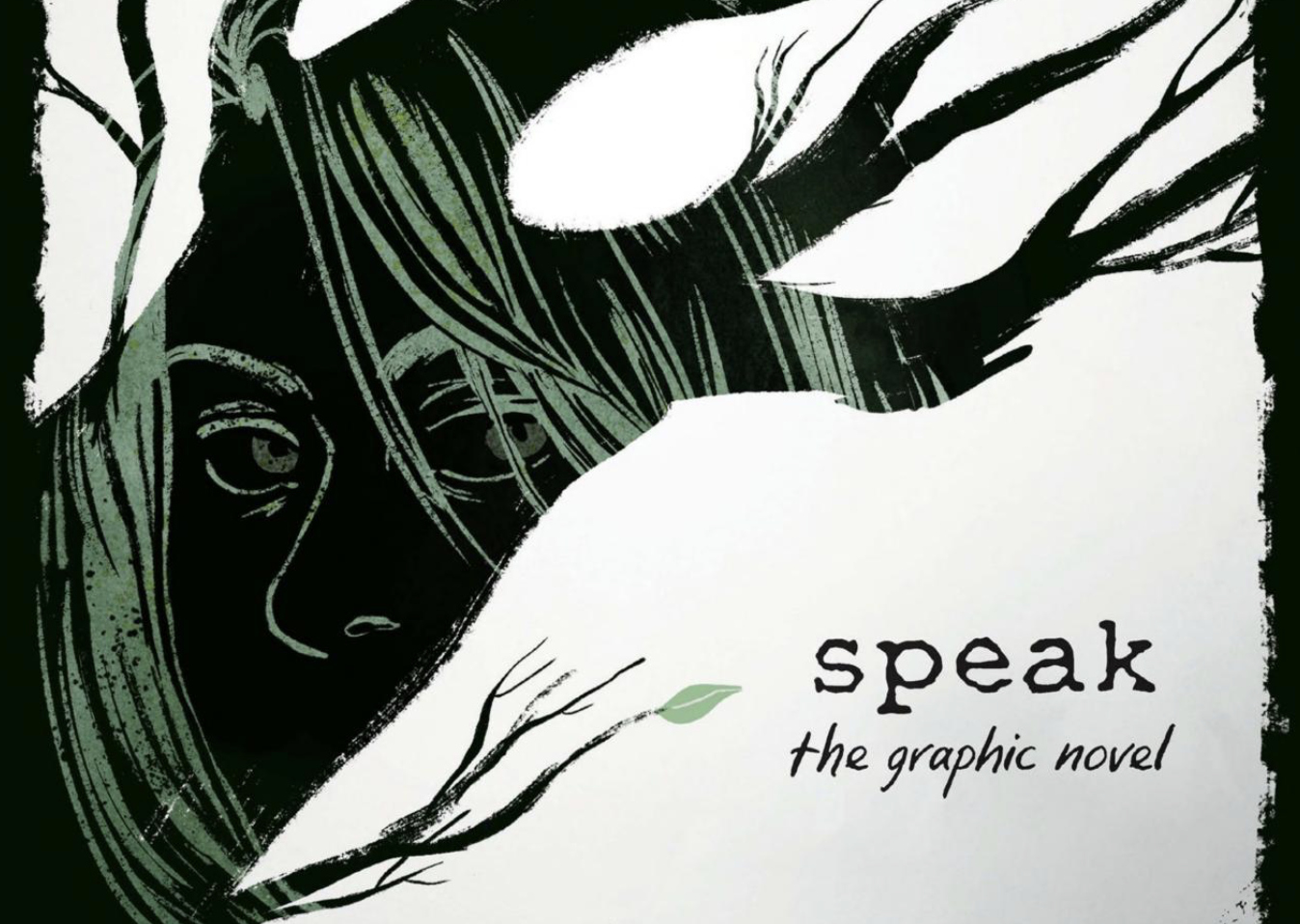
More often than not, the children’s literature genre is misrepresented as aiming to sanitise real world issues, introducing narratives containing conflicts that always end in happy resolutions. We reflect on children’s books as innocent, pure, devoid of real world consequences and danger. A form which repeatedly presents childhood and teenagehood in a raw, subversive fashion is the graphic novel, and in particular, graphic novels targeted at young adults exploring complex issues such as mental health and trauma. One such example is Speak: The Graphic Novel (2019), written by Laurie Halse Anderson and illustrated by Emily Carroll. This graphic novel is subversive in form and content, following Melinda Sordino, a fourteen-year-old high school student whose mental health deteriorates after she is raped at a party by a senior, and becomes afraid to speak out. Melinda struggles to find her voice and express her emotions with others, but gradually regains her confidence and sense of self, particularly through the empowerment art provides her.
Speak: The Graphic Novel is a subversive piece of children’s literature, depicting trauma and its effect on the child psyche. Melinda’s love for Mr Freeman’s art class, her fascination with Cubism and distortion, and her journey to finding her voice through connecting with other girls at school all reflect the harsh reality of coming to terms with trauma. The graphic novel is rendered a subversive art form by Anderson and Carroll, and its intertextuality a method of aesthetic distancing employed to allow Melinda to cope with the complexity of her pain. The aesthetic distancing is a stepping stone towards processing the sexual assault Melinda has suffered, but simultaneously never shies away from the ugliness of the abuse endured.
Perhaps the first example of subversion in Speak is Mr Freeman’s art classroom. The art classroom at Merryweather High School becomes a sanctuary for Melinda, an escape from the rest of the seemingly unsafe school environment which projects outdated socio-political ideas. Early on in the graphic novel, Melinda starts her first day at high school and enters the auditorium, pictured with a shadow cast on her, making her appear grey as if she fades into the walls. The exit depicted behind her is full of a bright white light, symbolising the freedom existing outside of school which she cannot reach. Her peers opposite her are depicted as black silhouettes, merging together like one uniform monster. In the text accompanying the panel, Melinda reflects: ‘I don’t have anyone to sit with. I am outcast.’

Both the text and illustrations highlight Melinda’s low self esteem and social anxiety. She views herself not as an outcast, but the embodiment of the outcast, almost inhuman. By labelling herself ‘outcast’, she describes herself as a noun, an object instead of a human being. This mirrors her emotions about the rape, how she feels like a shell of herself, objectified by Andy, her rapist, and left isolated and vulnerable. It is though a part of Melinda’s self has been stolen from her which she is fighting and struggling to regain. As a means of protection, Melinda aims to remain separate from her peers, who are depicted in the scene as a grouped black silhouette, out of fear they too will harm her.
Melinda’s mistrust in the school system and her peers continues, with several illustrations in the book displaying ‘lies they tell you in high school’. In Melinda’s first set of lies she believes schools tell, Anderson lists points such as ‘We are here to help you’, ‘Guidance counselors are always available to listen’ and ‘These will be the years you look back on fondly’. The pessimistic view Melinda voices about school may initially be read as presumptuous, but by the end of the novel, the reader acknowledges she was correct to doubt the system, as Melinda is dismissed and ignored repeatedly by members of staff who never investigate why her grades are declining. For instance, in her Spanish class, her classmates tease her and label her ‘Me-no-linda’, translating to ‘I’m not pretty’ in Spanish, but also a play on words as ‘linda’ is a shortened version of Melinda. Her teacher does nothing to protect her from the bullying classmates, nor scold them.
A similar situation occurs later in the novel when Melinda’s parents are called to the principal’s office about her grades, only for the conversation to propel into a screaming match between her parents, entirely moving the focus away from Melinda and her struggles. In one of the panels, Melinda’s principal is portrayed doodling a butterfly in his notepad when he is meant to be solving the issue of Melinda’s grades and how to help her. On the right of the panel, there is a jagged speech bubble from which exclamation points and stars concealing swear words are flying around during an argument between Melinda’s parents. These panels show how the principal turns a blind eye to Melinda’s problems and the pain she is suffering, ignoring the effects her home life may be having on her school work, as well as other contributing factors such as the assault she has endured. The principal is not curious or empathetic enough to try and uncover the root of Melinda’s problems.

Melinda herself reflects on the frustration she feels, asking: ‘Do they choose to be this dense or were they just born this way?’ when the principal and his assistant assume she is still friends with Heather and the Marthas, who have excluded her for not fitting into their shallow ideals. The principal and his assistant want to assume Melinda has a wide group of friends who influence her positively because they then won’t have to monitor her wellbeing so closely. Melinda is aware how little members of staff at Merryweather care about her, and this only worsens her depression, as she feels like a burden to everyone around her. In reality, Melinda is treated like an afterthought by Heather, used when she can help with art projects that advance Heather’s social hierarchy with the Marthas, and abandoned when suffering. The principal and his assistant have no idea about this, and make no effort to question Melinda further about her friendships or general wellbeing.
Mr Freeman’s art class is a contrast from the unpredictable, dangerous world Merryweather represents to Melinda. Early in the novel, Melinda describes ‘Art follow[ing] lunch like dream follows nightmare’, the simile reiterating how she views everything before art class as threatening and anxiety-inducing. Within the panel, the door outside the art classroom is portrayed as a solid black space, with the only light coming from the classroom itself and the windows. The shading renders all space outside the classroom a danger zone – areas Melinda might encounter her abuser or be forced to deal with unkind peers who label her the girl who ‘called the cops to bust Kyle’s party’, without knowing the reality of her situation. Light pours on Melinda’s figure, rendering her features more pronounced than when she entered the auditorium. In the art classroom, she does not fade into the background in grey, but instead appears brighter, as visible and seen as her classmates. Carroll’s illustrations skilfully indicate Melinda’s enhanced level of comfort and how the environment of the art classroom helps nurture her creativity.
The art classroom serves as more than a foil to the rest of Merryweather, since its purpose is also to allow Melinda to process her trauma and learn to speak about it in a productive, healthy way. As Jessi Snider argues, “Mr Freeman wants Melinda to speak the language of art, which can also be the language of subversion. Mr Freeman’s classroom does not represent or reflect the language of dominant cultural forces; instead, it encourages the voice of those actively in defiance of those forces.’ It is within Mr Freeman’s classroom that Melinda creates a painting for her final project, revisiting the woods she was raped within in a new light. The painting is presented to the readers at the end of the novel and depicts a tree with the sun pouring down on it after a period of snowfall. There is a large amount of light grey shading and areas where the image is overlaid with white, giving the tree an icy, wintry quality, mirroring fog on a snowy day.

Along the bottom and top of the painting, there are specks of white resembling snowdrops, reinforcing the winter theme Carroll is arguably trying to achieve. In the centre of the image two black birds fly freely, with the accompanying text ‘The frozen stillness melts inside me. Shards of ice drip onto the floor and vanish in the puddle of sunlight.’ The art classroom and Mr Freeman’s guidance have prompted this transformation, allowing Melinda, who could hardly face remembering the details of her rape, to revisit it in the form of a painting. The ‘frozen stillness’ Anderson writes of is the fear Melinda has been harbouring, the weight of holding onto the secret of her rape and the pain it has caused her. The ‘shards of ice’ in the painting literally ‘drip[ping] onto the floor and vanish[ing]’ is a metaphor for how as time passes, Melinda has been able to better process the trauma she has suffered, and can envision a hopeful future for herself.
Melinda’s final painting stands in complete contrast to the traumatic memories portrayed of the woods she was assaulted in, showing how she reimagines a triggering location. Caroll depicts Melinda’s memories through a flashback of the end-of-the-summer party she attends, where there are a series of perhaps the darkest illustrations in the novel, both in shading and mood. Displayed across a double-page spread, Melinda’s rapist, Andy, is pictured as a menacing shadow or silhouette hovering over Melinda and forcing her down into the ground.


The page is covered in text such as ‘NO!’ and ‘WHAM!’, emphasising Melinda’s lack of consent and the violent nature of the rape. In the centre of the double-page spread, a tree unites the two pages, merging into Andy’s hand at the bottom of the page. Around the outline of both pages are white branches and tree outlines which clash dramatically in their beauty and solidity with the horrific assault taking place. These pages are dominated by blacks and greys, whereas Melinda’s final painting is full of white light and softness, where the sky is visible and nature flourishes. The art classroom, simply as a location and “home”, inspires a painting allowing Melinda to empower herself, expressing her pain and healing journey in a subversive manner.
The act of including graphic scenes depicting Melinda’s memories of the rape or alluding to it through her painting is a subversive move on behalf of Anderson. Discussing rape and sexual assault even in an adult context can be taboo, but in children’s and YA literature, it is incredibly uncommon. Despite research highlighting that one in 20 children in the UK have been sexually abused, it is rare to discover children’s or YA books which directly address the issue. Speak: The Graphic Novel discusses child sexual abuse directly, whilst labelling the age range for 12-18 year olds. This is arguably a bold choice on Anderson’s behalf, as many would argue that since the book contains “adult content”, it should not be marketed for children. However, I would argue, as does Anderson, that whilst children and teenagers are still experiencing sexual assault, there is necessity for honest conversations and representations, and without them, many childrens’ experiences will be erased. In an interview with Refinery29, Anderson argued: “We have to recognize that teaching your kids about consent and healthy sexuality is every bit as important as teaching them how to cross the road or how to drive a car.” This psychology is the basis on which Speak is built from – never patronising children, but educating them in an accessible way through the graphic novel format.
There are several stages Melinda goes through within Mr Freeman’s art classroom before she is able to produce her final painting, and this involves experimenting with the art movement Cubism, and distortion of reality. Throughout the entire novel, Melinda experiences a dichotomy between appearance and reality. Her peers view her as the girl who ‘called the cops to bust Kyle’s party’ and as a result, misconstrue her truth. They do not see the reality – that Melinda has suffered traumatic abuse, and desperately needed help the night of the party. Similarly to the principal and his assistant who form assumptions about Melinda and her friendships, her peers make judgements about her and project them onto her. At a football game, she is verbally attacked by a girl who blames Melinda for her brother losing his scholarship at university because he was caught underage drinking at the summer party. Another girl pushes Melinda down the stairs, claiming she is ‘Not sorry’, implying Melinda deserves to be treated badly for causing students to have been arrested. Even Melinda’s temporary friend, Heather, makes fun of her behind her back with the Marthas for her scarred lips, with one girl describing Melinda as looking like ‘she has a disease or something’. Where Melinda desperately needs to be met with kindness and gentleness, she is met instead with abuse and mockery. The horrible comments people make about her shape and distort her sense of self, making her question her worth and character.
As a result of this confusion, Melinda forms a fascination with artwork exploring the distortion of reality. Within Mr Freeman’s art class, Melinda begins expressing the injustice she feels about people’s perceptions of her, and how they differ from the reality of who she is and what she has experienced. One of the first examples of this is the sculpture Melinda makes of the wishbone Barbie. The finished piece takes up a whole page, with an entirely solid black background.

The panel at the top of the page shows Melinda attaching tape across the Barbie’s mouth, literally and figuratively silencing her. In the centre of the page, the wishbone sculpture stands alone, the doll’s body separated from its head with outstretched arms. Below, a knife and fork represent splayed feet, and there is wire wrapped around various parts of the sculpture resembling rope or handcuffs. The piece Melinda creates unmistakably evokes rape imagery, with the tape plastered to the doll’s mouth mirroring Andy’s hand over her mouth during the assault. Even the feet the doll is provided with, the cutlery edging in opposite directions, mimics the way Melinda’s body was forcibly taken by Andy, accessed without consent. The doll is naked, with no clothes protecting her modesty. She is stripped down to her bare bones, her vulnerability spotlighted. The rawness of this sculpture, which Mr Freeman argues ‘means pain’, allows Melinda to express her overwhelming emotions and the trauma she has endured in silence. The sculpture is proof Melinda no longer wants to remain silent, but desires to be heard, seen, to reclaim her sense of self.
The concepts of distortion and multiple perspectives complement the art movement Cubism, which Melinda learns about during art class and is also inspired by. Prior to this, Melinda imagines herself as a distorted figure several times in the novel. After overhearing Heather and the Marthas insulting her lips, she rushes to the toilet to wash her face, imagining it disappearing entirely so she is left with ‘no eyes, no nose… no mouth’.

She is depicted with no discernible facial features, simply a smeared, warped greyness covering her face, again making her appear subhuman. On the page beside this one, Melinda stares into a shattered mirror, the background fully black, describing herself as ‘A Slick NOTHING.’ Melinda’s negative thoughts and emotions are influencing her sense of self to a degree where she cannot separate fiction from reality. Since her mental health is in such a desperate state, she begins to view herself in a distorted manner and experiences a kind of facial, body dysmorphia, where she cannot see herself for who she truly is, but a projection of other people’s perceptions of her.
This disordered sense of self is again portrayed when Melinda visits her mother’s clothing shop. In the changing rooms, she imagines herself staring at a different version of herself with various pairs of scarred lips emerging monstrously from her face. The accompanying text reads: ‘What does it feel like to walk in a new skin?’, emphasising her unhappiness with being in her own body, and her curiosity as to what it would be like to inhabit someone else’s. Her current self is portrayed as a black silhouette, staring at the new monstrous version, whose eyes are replaced with Melinda’s scarred lips. The fact that the new self Melinda imagines is so disturbing and inhuman highlights how she is unable to envision a positive future for herself. She cannot imagine any version of herself that isn’t chained by fear and post-traumatic stress.

That is until she continues her journey as an artist, discovering Cubism. Within Mr Freeman’s classroom, Melinda reflects how ‘Cubism… seeing beneath the surface… stole my breath away.’ Over a double page spread, Carroll depicts Melinda at work in the art classroom, with Cubist illustrations covering both pages.


Cubism not only inspires Melinda’s final painting, it allows her to reevaluate her sense of self, regaining her confidence. When Mr Freeman gives Melinda a lift to her mother’s store, he tells her ‘I think you have a lot to say. I’d like to hear it’. As he speaks, Melinda imagines him as a Cubist painting, waving at her. Carroll distorts Mr Freeman’s face, separating it into distinct shapes and experimenting with light and dark shading to emphasise his two-dimensionality, how he too can be reduced to a character on a page, but one with many layers. This highlights how Mr Freeman consistently influences Melinda to challenge herself artistically and to indulge in subversion without guilt. Melinda is able to envision Mr Freeman as a Cubist painting because he inspires her to use her imagination, and because he is a figure she feels safe around. He actively encourages her to speak and express herself through her artwork, standing in conflict with her negative subconscious which tells her ‘Nobody really wants to hear what you have to say’. Andy also stands in contrast to Mr Freeman’s encouragement, attempting to silence Melinda. When he attacks her a second time, he remarks: ‘You have a big mouth, know it?’, implying Melinda has spread misinformation about him around Merryweather. Ironically, throughout the novel, Melinda hardly shares with anyone the abuse she has suffered, protecting Andy’s reputation by-proxy. It is this method of thinking that Mr Freeman encourages Melinda to break with through her art. Though he is unaware of the situation Melinda has suffered, he observes she has ‘a lot to say’, and is himself thinking in a Cubist manner, beneath the surface, towards a version of Melinda that is her most authentic self.
Within Speak, there is Melinda’s journey towards acceptance and healing, and the reader’s towards the reality of her situation. Graphic novels are themselves a subversive art form, and it is through Speak’s intertextuality this is reflected. Speak employs what Joti Bilkhu refers to as ‘aesthetic distancing’ – “the use of both visual and verbal techniques to create[…] what Jacqueline F. Eastman terms ‘controlled danger’ where the narrative becomes ‘comfortably exciting rather than overwhelming’”. However, there are also moments within the novel where the aesthetic distancing is rejected, and the reality of Melinda’s pain is clear to young readers. Within Speak, Melinda repeatedly characterises herself as a bunny rabbit, running from Andy – a wolf and beast. This is a clear reference to Little Red Riding Hood, which has undertones of sexual violence and gendered power imbalances. When Melinda runs into Andy outside a coffee shop, she claims he ‘wolfsmiles, showing oh granny what big teeth you have.’ She pictures herself, the ‘Bunny Rabbit’, bolting away, and Caroll accompanies this with a line running along the page mirroring fog from the snow, with the words ‘get away’ written repeatedly. The aesthetic distancing allows Melinda to separate herself from the true reality of her situation, ‘without facing a psychological proximity for which she may not be ready’. However, Anderson does not separate Melinda so much from her own reality that she is not depicted as frightened or intimidated of Andy. Andy’s calm, arrogant demeanour in comparison to Melinda’s desperation to escape clearly indicates she is in a state of danger, and even the youngest readers of the YA genre would be able to pick up on these subtleties.
The reader sees further examples of gendered power imbalances when Andy converses with the girls in the International Club, and Melinda views him as a dark wolf with sharp teeth. She refers to him as ‘Andy Beast’, as though he is not human but a villainous creature set to cause her harm. Such direct portrayals of Melinda’s anguish disprove views such as Angela E. Hubler’s that ‘Speak does not show that rape results from “gendered power relations”[…] due to[…] [the] first-person narration that presents the perspective of a fourteen-year-old who lacks an understanding of factors that contribute to rape’. When the aesthetic distancing is partly rejected such as in this scene, the reader clearly sees how Melinda is forced into silence, whilst Andy continues his social life without consequences. To claim Melinda’s narration lacks understanding about ‘factors that contribute to rape’ is inaccurate, when the intertextual references make it abundantly clear that what Andy gains from assaulting Melinda and her silence is a sense of power. Whilst he roams comfortably around school, Melinda lives in constant fear. Whilst Melinda stays silent, Andy maintains his positive reputation.
The purpose of the aesthetic distancing used within Speak is arguably to make the topic of sexual assault more accessible to younger readers, without sanitising it and leaving readers oblivious to the pain and suffering experienced. However, the aesthetic distancing is frequently rejected or only partly used by Anderson and Carroll. This is particularly the case towards the end of the novel where Melinda takes control of her narrative and uses her voice to warn other girls at Merryweather about Andy. She writes on the bathroom walls: ‘Guys to stay away from: ANDY EVANS’ and underlines this to add emphasis. Melinda’s writing is essentially a form of graffiti – yet another subversive art form – used to rebel against Andy’s abuse, and the power he holds over her. Such scenes continue to disprove Hubler’s argument that Speak doesn’t ‘offer the example of collective feminist action’ or that it doesn’t ‘challenge the rape culture that[…] individualizes blame and discourages social analysis’. Melinda’s act of rebellion empowers other girls at Merryweather to write on the bathroom wall about their negative experiences with Andy. Carroll uses an entire page to showcase the wall with messages such as ‘he’s a BASTARD’, ‘SHOULD B LOCKED UP’ , and ‘I went to the movies w him and he put his hands down my pants during PREVIEWS’. Melinda is pictured with her hand over her mouth in shock, surprised at how many other girls have been treated similarly. At the bottom of the page in Melinda’s interior monologue, Anderson writes: ‘I feel like I can fly.’ Not only has Melinda found her voice, she empowers other women to speak out. The pride and joy she feels is overwhelming, and represents a turning point in terms of her confidence and selfhood.

Melinda’s accompanying words to her final painting perhaps truly confirm she has regained her voice. ‘You’ve been through a lot, haven’t you?’ Mr Freeman says, to which she answers ‘Let me tell you about it.’ This line dominates an entire black page, with the white writing the only other source of colour. She is no longer afraid of the consequences of speaking out about the rape, and has reached an understanding that the assault was never her fault, and never will be.
Overall, Speak: The Graphic Novel embodies the language of subversion through the progression of Melinda’s artwork and how it empowers her to discuss and process her rape. The use of intertextuality and references to experimental art movements such as Cubism all reflect the subversive nature of the graphic novel, and how as a work of children’s literature, Speak refuses to let children and young adults be patronised or neglected, educating them on important world issues, and providing representation for children who have suffered sexual abuse themselves.
Bibliography
Apollinaire, Guillaume, and Dorothea Eimert. 2010. Cubism. New York: Parkstone International. https://search.ebscohost.com/login.aspx?direct=true&AuthType=sso&db=cat07845a&AN=uea.777400926&authtype=sso&custid=s8993828&site=eds-live&scope=site.
Bilkhu, Joti. 2023. “Laurie Halse Anderson’s speak: the graphic novel: creating and resisting aesthetic distancing to discuss the trauma of sexual violence.” Journal of Graphic Novels and Comics 14 (3): 441, 445. https://doi.org/10.1080/21504857.2022.2152068.
Halse Anderson, Laurie, and Emily Caroll. 2019. Speak: The Graphic Novel. London: Hachette Children’s Group.
Hubler, Angela E. 2017. “It is Not Enough to Speak: Toward a Coalitional Consciousness in the Young Adult Rape Novel.” Children’s Literature 45:121, 125. https://doi.org/10.1353/chl.2017.0006.
Nicolaou, Elena. 2019. “Speak Is A Classic YA Novel. 20 Years Later Comes The Searing Personal Followup.” Refinery29. https://www.refinery29.com/en-us/2019/03/226609/laurie-halse-anderson-shout-memoir-speak-sequel-interview.
Radford, L., et al. 2024. “Statistics on child sexual abuse.” NSPCC Learning. https://learning.nspcc.org.uk/research-resources/statistics-briefings/child-sexual-abuse .
Snider, Jessi. 2014. “’Be the Tree’: Classical Literature, Art Therapy, and Transcending Trauma in Speak.” Children’s Literature in Education 45:304. 10.1007/s10583-014-9221-3.
Wolfe, Shira. n.d. “Art Movement: Cubism. The Radicality of Fragmentation.” Artland Magazine. Accessed May 23, 2024. https://magazine.artland.com/cubism/.
Leave a Reply